
ISO/IEC 27090: AI Security Without a New System
ISO/IEC 27090:2026 gives guidance on cybersecurity threats specific to AI systems. For organizations already running ISO/IEC 27001 and 42001, the most efficient path is to extend what they have rather than build new standalone structures.
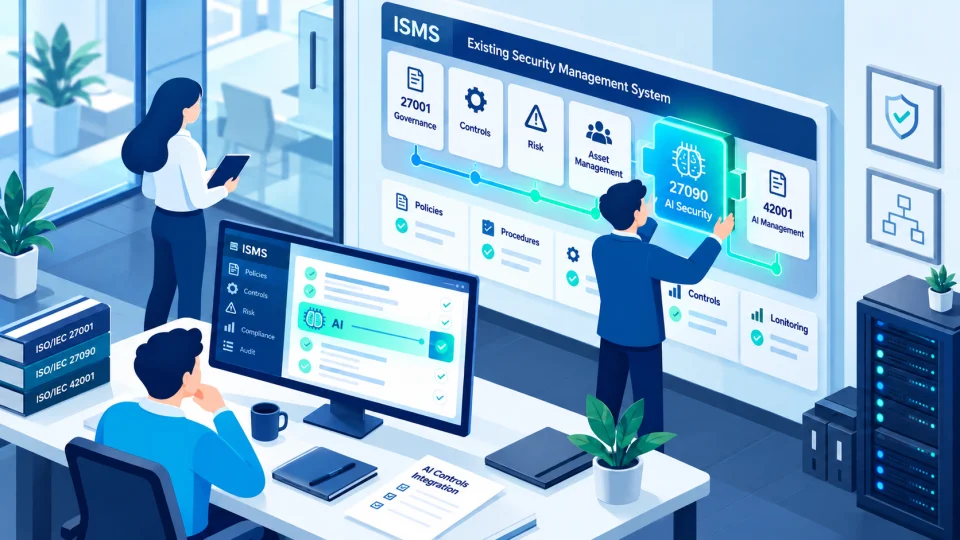
ISO/IEC 27090:2026 has been published. It offers guidance on cybersecurity↗ threats specific to AI systems, covering the whole lifecycle from training-data manipulation and model theft to risks in day-to-day operation. The practical question for most organizations is whether their existing ISO/IEC 27001 (ISMS) and ISO/IEC 42001 (AIMS) programs are already enough.
From cybersecurity to AI security
AI adds new components to the traditional attack surface↗. Threats such as prompt injection↗, especially for large language models, are not fully covered by classic controls. Technical controls alone are not enough either: acceptable risk, conditions of use and accountability need to be defined explicitly.
Five references, one management approach
These five references are complementary, not alternatives:
- ISO/IEC 27001: information security↗ management system (ISMS)
- ISO/IEC 42001: AI management system (AIMS)
- ISO/IEC 27090: cybersecurity guidance specific to AI systems
- ISO/IEC 42005: assessing the impact of AI systems on individuals and society
- NIST AI RMF: AI risk management↗ framework
The goal is not to stand up five separate management systems, but to bring these different perspectives into the processes you already have.
How organizations should apply it
- Inventory: Start by listing every AI system in use, including external services, API integrations and AI agents.
- Risk assessment↗: Cover more than information security: output reliability, impact on users and misuse as well. An AI agent with access to corporate documents is a good example of why the scope needs to be this broad.
What to do, depending on the standard you run
- ISO/IEC 27001 only: Review the ISMS scope so that it includes AI systems.
- ISO/IEC 42001 only: Strengthen the technical security side within the AIMS.
- Both: Share one inventory, one set of risk records and one control framework, and avoid repeating the same control for each standard.
A 90-day roadmap
- Days 1–30: Inventory, gap analysis and prioritization.
- Days 31–60: Update risk assessment methods, clarify policies and responsibilities, and add testing for high-risk systems.
- Days 61–90: Test control effectiveness, then update reporting and internal audit.
Keeping compliance sustainable
AI governance↗ is not only an IT or information security job. Senior management, business units, legal and compliance, and internal audit all have roles. Review frequency should follow risk level and be refreshed whenever a model or its use changes. Following a guideline is also not the same thing as being certified.
Bottom line
The most efficient approach is to extend existing management systems with AI-specific requirements instead of building new standalone structures. Securing AI systems is a technical requirement; managing that security in a sustainable and accountable way is an organizational responsibility.
Note: These assessments are based on publicly available information and preview content, without access to the full text of the standard. They should not be read as a detailed conformity analysis.
Source: Safa Paksu, LinkedIn