
AI Pentesting vs. Human Pentesters: Where Each One Wins
A new comparison of AI-driven and human penetration testing finds each approach has distinct strengths, suggesting the two work best together rather than as substitutes.
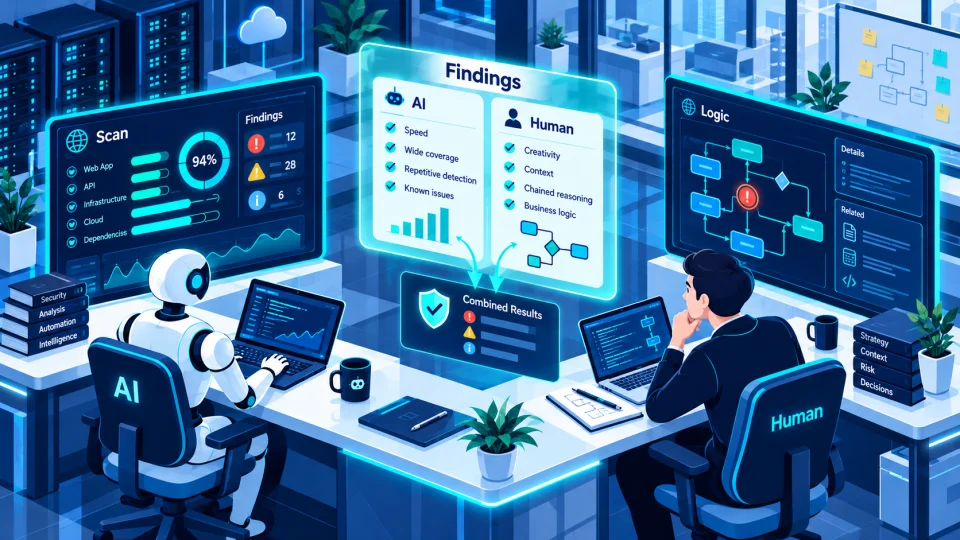
Can AI Replace a Human Pentester?
Penetration testing↗, or "pentesting," is the practice of simulating real-world attacks against systems and applications to find security weaknesses before criminals do. For years it has been a largely manual discipline, carried out by skilled security professionals working through structured methodologies. Now, AI-driven pentesting tools are entering the picture, raising a practical question for organizations: can an AI agent do the job as well as a trained human?
A recent industry comparison from security testing provider Intruder examined how AI-based pentesting stacks up against traditional human-led assessments. The analysis suggests that rather than one approach making the other obsolete, AI and human testers tend to excel in different areas, and combining them may offer the most complete picture of an organization's security posture.
Where AI Pentesting Shows Strength
AI-driven testing tools can work through entire codebases in detail, something that would be impractical for a human tester operating within the time constraints of a typical engagement. According to the comparison, this thoroughness has already paid off in real cases: an AI pentesting tool uncovered a complex authentication↗ bypass that had gone unnoticed through five years of annual human-led tests.
Other advantages cited include:
- Detailed remediation guidance: AI tools can provide specific, line-by-line fix recommendations, which in one case helped a customer resolve 78 identified issues within days.
- Lower cost and on-demand availability: Because AI testing is cheaper to run than a full human engagement, organizations can test more frequently rather than relying solely on an annual audit.
- No scope creep from back-and-forth: AI tools don't need clarifying conversations with stakeholders, which can keep testing focused and efficient.
Where AI Pentesting Falls Short
The comparison also points to clear limitations. AI agents cannot pause to ask a stakeholder for context the way a human tester can, which matters when understanding business logic or the real-world impact of a flaw. Risk scoring from AI tools also tends to skew cautious, since the underlying language models are tuned toward flagging potential security concerns rather than weighing business context.
Consistency is another issue. Because AI agents make autonomous decisions about what to investigate and how, results can vary between runs of the same test. Additionally, many AI pentesting approaches currently require "white-box" access, meaning they need visibility into source code, rather than testing a system purely from the outside as an attacker would.
What Human Testers Still Bring
Experienced human pentesters remain valuable for their ability to notice subtle, anomalous behavior and follow unexpected leads that don't fit a predefined checklist. Much of the real value in a skilled human assessment comes from intuition and experience gained outside of rigid methodology, areas where structured processes alone can create a false sense of complete coverage.
That said, human testing has its own constraints: results can vary significantly depending on an individual tester's background and expertise, and testers are typically limited by engagement timelines and, like AI tools, don't always have source code access.
What This Means for Organizations
The takeaway for security teams is not that AI pentesting should replace human assessments, or vice versa, but that each method covers different gaps. AI tools can provide continuous, scalable coverage of known vulnerability↗ classes and codebases between scheduled audits, while human testers remain better suited to uncovering context-dependent issues and following creative attack paths.
- Consider AI-driven testing as a complement to, not a replacement for, periodic human-led assessments.
- Use AI tools for frequent, lower-cost checks between formal pentest cycles.
- Keep human expertise involved for assessing business context, risk prioritization, and unusual attack scenarios.
- Treat any single testing methodology, human or AI, as one layer of a broader security program rather than a complete guarantee of safety.
As AI testing tools mature, the gap in some areas may narrow, but for now a layered approach that draws on the strengths of both appears to offer the most reliable path to finding and fixing vulnerabilities.
Source: BleepingComputer